
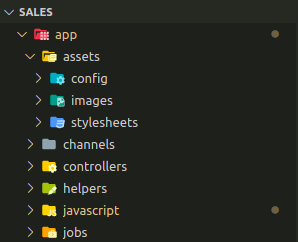
Assets
In Ruby on Rails there is something called “Asset Pipeline”, this is useful for combining/compressing assets such as Javascript & CSS and image files (.jpg, .png, etc.). In these assets we can also combine features in the gem by calling them in the CSS or JS file.
- Style sheets for the CSS file storage folder.
- JavaScript for js file storage folder.
- Pictures for image file storage folders (.jpg, .png etc.)
How to call CSS by adding *= requires nama_file_css
*= require_self used when the file application.css will also be used to write CSS code.
*= require_tree. to call all CSS files in the folder resources/style sheets
Note: as for end that is to say the opposite of require to exclude/remove CSS when we use require_tree and a CSS is not needed, so use the method end (Example: *= stub nama_file_css)
Not much different from CSS, adding JavaScript is usually placed in a folder application/javascripts/packs with master file application.js

Just like CSS, only the js file is called via import, see image above
Layouts and display
Now after setting up the assets section, to call it in the view we simply add the following code
- For CSS
<%= stylesheet_link_tag 'application', media: 'all' %> - For javascript
<%= javascript_include_tag 'application', media: 'all' %>
That’s it for this lesson on adding CSS and Javascript to Ruby on Rails. We hope this tutorial will be an easy-to-understand lesson for all of us. Stay tuned.
Dicky Trifadillah | C-aio Indonesia
PakarPBN
A Private Blog Network (PBN) is a collection of websites that are controlled by a single individual or organization and used primarily to build backlinks to a “money site” in order to influence its ranking in search engines such as Google. The core idea behind a PBN is based on the importance of backlinks in Google’s ranking algorithm. Since Google views backlinks as signals of authority and trust, some website owners attempt to artificially create these signals through a controlled network of sites.
In a typical PBN setup, the owner acquires expired or aged domains that already have existing authority, backlinks, and history. These domains are rebuilt with new content and hosted separately, often using different IP addresses, hosting providers, themes, and ownership details to make them appear unrelated. Within the content published on these sites, links are strategically placed that point to the main website the owner wants to rank higher. By doing this, the owner attempts to pass link equity (also known as “link juice”) from the PBN sites to the target website.
The purpose of a PBN is to give the impression that the target website is naturally earning links from multiple independent sources. If done effectively, this can temporarily improve keyword rankings, increase organic visibility, and drive more traffic from search results.
