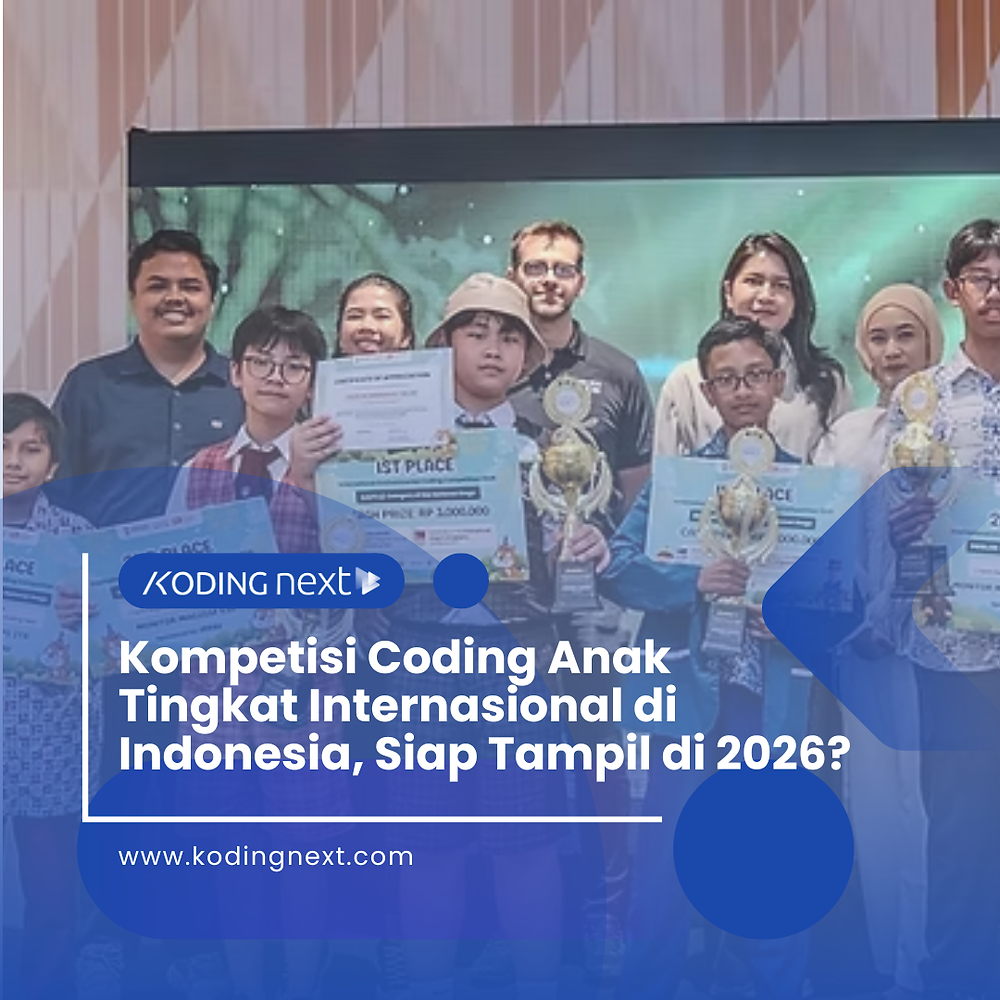
Have you ever imagined your child standing on the stage of an international coding competition, competing against amazing kids from around the world? This is not just a dream, because the opportunity is real and Indonesia already has a path to travel.
We know that the digital world is evolving very quickly. Kids learning to code today aren’t just playing with blocks of code, they’re laying the foundation for a future career. And one of the best ways to hone their skills is to participate in real coding competitions for kids, not only locally but also internationally.
What is the International Coding Competition for Kids?
The International Kids Coding Competition is a prestigious event where children from different countries show off their coding skills, from creating animations, games to technological solutions that address real-world challenges.
Different from ordinary science or math competitions, coding competitions encourage children to think creatively and systematically. They have to design projects, write code, and present ideas, all in one incredibly valuable set of experiences.
What makes this competition interesting is the ranked levels. From the qualifying selection, regional and national events to the international grand final. Each stage simultaneously builds children’s mental and technical abilities and self-confidence.
Indonesia has proven it, IECC 2025 brings together 9 countries
Last year, Koding Next, the largest coding, AI and robotics school for children in Southeast Asia, organized with Marshall Cavendish the International Environmental Coding Competition (IECC) 2025, an international coding competition for children inspired by Sustainable Development Goals (SDG) 13.
The IECC 2025 is no ordinary competition. This competition combines two things that are very relevant in the modern era, namely coding skills and concern for the environment. Participants are invited to create coding works in the form of animations via Scratch or games via Roblox that focus on environmental issues such as climate change and nature conservation.
What is most encouraging is that this competition successfully brought together children from 9 countries, namely Indonesia, Malaysia, Singapore, Philippines, Thailand, India, China, Saudi Arabia and Bangladesh. An extraordinary achievement that proves that Indonesia is not only a participant but also a major player in the international coding scene.
The enthusiasm of Indonesian children is also very encouraging. More than 2,500 children from all over Indonesia registered and participated in the IECC 2025 qualification stage. This figure is not just a statistic, but a real reflection that Indonesia’s young generation is ready to compete on a global level.
The IECC competition system is designed to be fair and tiered. During the qualification phase, participants with the 10 highest scores in each category advance to the next round. From there, the top two in each category at each Koding Next location advance to the national stage. The national level winners of the Scratch and Roblox categories then had the opportunity to fly to Singapore to compete against winners from 8 other countries.
Why is it important to participate in coding competitions for kids?
Many parents wonder why should children participate in coding competitions if they are already learning to code regularly? Aren’t regular classes enough? The answer is simple. Learning without real challenges is like swimming without water. Coding competitions provide experiences that cannot be replaced by regular classes.
-
First, hone your critical thinking
In competition, children are faced with deadlines, technical rules and quality expectations. They learn to solve problems systematically and efficiently, this skill is very valuable in the real world and later in the working world. -
Second, develop self-confidence
Children who have performed in front of judges and international audiences have a different courage. They know they are capable and it changes the way they view themselves. -
Ketiga, opens networks and opportunities
International competitions are an opportunity for children to meet talented friends from all over the world. Networks built early can be valuable capital in the future, both for careers and for collaborations and scholarships. -
Fourth, a real wallet
In the digital age, portfolios speak much more than grades on report cards. Projects created for international coding competitions can be a huge advantage when your child applies to prestigious universities or programs in the future.
Get ready, the 2026 International Coding Competition is coming!
After the huge success of IECC 2025 involving 9 countries and thousands of participants, one of the most asked questions is when the next competition will take place.
International Coding Competition 2026 future! And the best time to prepare is now, not tomorrow, not next month.
Kids who start learning to code today will have a huge advantage over those who wait. Every training session, every project completed and every challenge overcome is a true investment in future competitive performance.
So where should kids start to prepare for this international coding competition?
Learn coding at Koding Next, the best preparation before the competition
Although the IECC is open to all children, showing up with careful preparation is certainly a different story. This is where Koding Next can be the right study partner.
Next coding offers coding classes for kids ages 4-16 with a curriculum designed around age ranges and abilities.
-
Little Koders (4-7 years old) is a fun and interactive introductory coding program. The approach is visual and fun, suitable for children who are discovering the world of programming for the first time.
-
Junior Koders (8-16 years) is a more in-depth program, covering Scratch, Roblox, Python, and various other programming languages. This is the most relevant way to prepare children for coding competitions like the IECC.
-
Robotics (4-17 years) suitable for children who want to combine coding and robotics, opening up opportunities in the technological field that will be increasingly in demand in the future.
Koding Next not only teaches coding, but also develops children’s whole way of thinking, from the technical side, through creativity, to the courage to show their work in public. First trial lesson too FREEso there is no harm in trying.
It’s time for your child to take the world stage
Coding competitions for kids aren’t just about winning or losing. It’s about creating a generation that dares to dream big, is able to think creatively and is ready to make a real contribution to the world through technology.
The IECC has proven that Indonesian children can compete at the international level. Last year, more than 2,500 children took the first step. Now it’s your child’s turn. If you want your child to be ready to compete in IECC 2026, start learning now with Koding Next. Sign up for your first free class and see the progress for yourself.
Learn more about the learn to code program at kodingnext.com or try your child’s first lesson for free at
PakarPBN
A Private Blog Network (PBN) is a collection of websites that are controlled by a single individual or organization and used primarily to build backlinks to a “money site” in order to influence its ranking in search engines such as Google. The core idea behind a PBN is based on the importance of backlinks in Google’s ranking algorithm. Since Google views backlinks as signals of authority and trust, some website owners attempt to artificially create these signals through a controlled network of sites.
In a typical PBN setup, the owner acquires expired or aged domains that already have existing authority, backlinks, and history. These domains are rebuilt with new content and hosted separately, often using different IP addresses, hosting providers, themes, and ownership details to make them appear unrelated. Within the content published on these sites, links are strategically placed that point to the main website the owner wants to rank higher. By doing this, the owner attempts to pass link equity (also known as “link juice”) from the PBN sites to the target website.
The purpose of a PBN is to give the impression that the target website is naturally earning links from multiple independent sources. If done effectively, this can temporarily improve keyword rankings, increase organic visibility, and drive more traffic from search results.