RSpec is a unit testing framework for the Ruby programming language. RSpec differs from traditional xUnit frameworks such as JUnit because RSpec is a behavior-based development tool. This means that tests written in RSpec focus on the “behavior” of the application under test.
RSpec is a DSL for creating executable examples of how code should behave, organized into groups. He uses the words “describe” and “that” so we can express concepts like conversation:
"Describe an account when it is first opened."
"It has a balance of zero."
1. configure and install ror and rspec
Create a new application with the following command
rails _7.0.1_ new sample_unit_test --api -d postgresqlgo to the directory we created
cd sample_unit_test open the Gemfile and add the ‘rspec-rails’ gem
go back to terminal and run
bundle install create a database with run
bundle exec rake db:create configure rspec on rails with the following command
bundle exec rails generate rspec:install 2. Create a client model and raw features whose functionality we will test
bundle exec rails g scaffold customer name:string phone:bigint email:string address:textbundle exec rake db:migrateedit app/models/customer.rb add validation
 class Customer < ApplicationRecord
  validates :name, :email, presence: true
 end
3. update rspec file
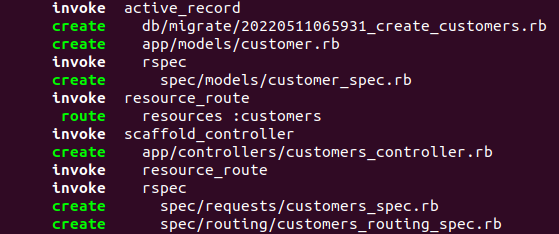
When we run the scaffold ror command, it will also automatically create a test file
| Image of the generated scaffolding |
To test the customer controller, edit the file in spec/requests/customers_spec.rb
 |
| default isi file dari customer test request |
Because the content is still empty, we need to fill in the correct attributes and use the “fake” gem to help match the data.
let(:valid_attributes) do
   { name: Faker::Name.name,
    phone: Faker::Number.number(digits: 12),
    email: Faker::Internet.email,
    address: Faker::Address.street_address }
  end

  let(:invalid_attributes) do
   { name: nil,
    phone: nil,
    email: Faker::Internet.email,
    address: Faker::Address.street_address }
  end

  let(:valid_headers) do
   {}
  end
valid headers are left empty because this tutorial does not use security tokens
after adding valid_attributes and invalid_attributes try testing with the following command
bundle exec rspec spec/requests/customers_spec.rb  |
| Image after updating valid and invalid attributes |
In the error description there are two processes waiting because there is a time skip in the update section
reopen the following file
spec/requests/customers_spec.rb  |
| Updated part of Gambar’s default code |
The skipped section must be replaced according to the description of the new attribute, i.e. the data content. new_attributes To replace the old data, the content looks like the code below
    let(:new_name) { Faker::Name.name }
    let(:new_attributes) do
     { name: new_name,
      phone: Faker::Number.number(digits: 12),
      email: Faker::Internet.email,
      address: Faker::Address.street_address }
end it 'updates the requested customer' do
customer = Customer.create! valid_attributes
patch customer_url(customer),
params: { customer: new_attributes }, headers: valid_headers, as: :json
customer.reload
expect(customer.name).to eq(new_name)
end bundle exec rspec spec/requests/customers_spec.rb  |
| Image of passed test results without failure |
Test the customer model update spec/models/customer_spec.rb as follows, then run the tests
 require 'rails_helper'
 RSpec.describe Customer, type: :model do
  it 'is not valid without a name' do
   customer = Customer.new(name: nil)
   expect(customer).to_not be_valid
  end
  it 'is not valid without a email' do
   customer = Customer.new(email: nil)
   expect(customer).to_not be_valid
  end
 end
testing for client models here is just a validation, in fact there can be a lot depending on the content of the model
PakarPBN
A Private Blog Network (PBN) is a collection of websites that are controlled by a single individual or organization and used primarily to build backlinks to a “money site” in order to influence its ranking in search engines such as Google. The core idea behind a PBN is based on the importance of backlinks in Google’s ranking algorithm. Since Google views backlinks as signals of authority and trust, some website owners attempt to artificially create these signals through a controlled network of sites.
In a typical PBN setup, the owner acquires expired or aged domains that already have existing authority, backlinks, and history. These domains are rebuilt with new content and hosted separately, often using different IP addresses, hosting providers, themes, and ownership details to make them appear unrelated. Within the content published on these sites, links are strategically placed that point to the main website the owner wants to rank higher. By doing this, the owner attempts to pass link equity (also known as “link juice”) from the PBN sites to the target website.
The purpose of a PBN is to give the impression that the target website is naturally earning links from multiple independent sources. If done effectively, this can temporarily improve keyword rankings, increase organic visibility, and drive more traffic from search results.